
An article appearing in the next issue of:
The First Juneteenth:

Black Churches, Reconstruction Politics, and the Houston Origins of June 19 Celebrations
by W. Caleb McDaniel
W. Caleb McDaniel is Mary Gibbs Jones Professor of Humanities at Rice University. For helpful comments on earlier drafts of this article, the author thanks Debra Blacklock-Sloan, Sam Collins III, Randal Hall, Karen Kossie-Chernyshev, seminars at Rice University and Johns Hopkins University, and the anonymous reviewers for the Journal of Texas History.

Published with the support of:

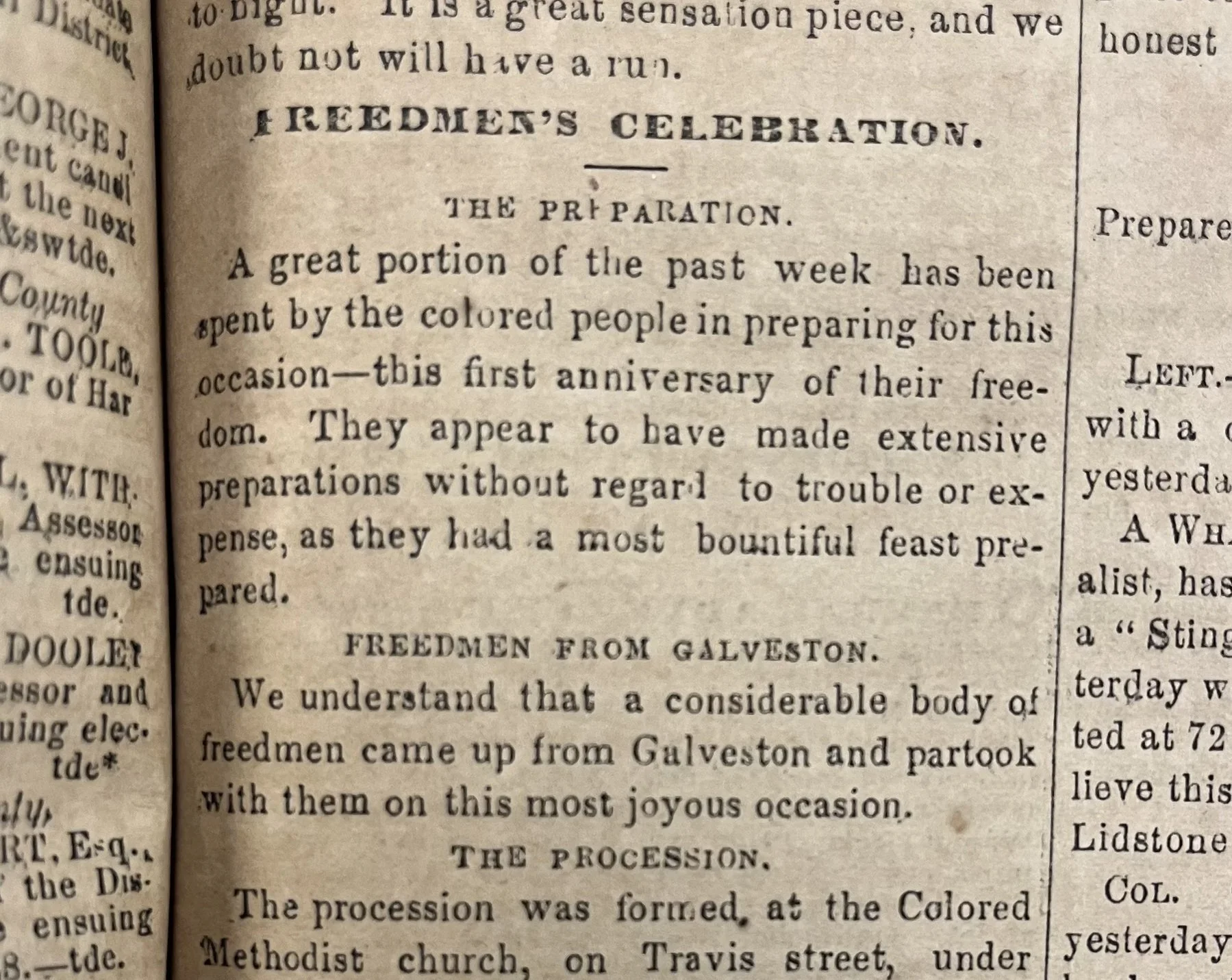
On June 19, 1866, several thousand Black Texans filled the streets of Houston for the first “celebration of the anniversary of their freedom.” That morning, according to newspaper reports, the crowds assembled on a city block in the Fourth Ward, where Black Methodists had recently erected a church. Waving US flags and banners of red, white, and blue, they paraded through the center of town, led by two ministers: Elias Dibble as president and Sandy Parker as marshal. They marched to a grove in the Second Ward for speeches, music, and a meal, and then they returned to the neighborhood where the parade began. One local newspaper recognized the whole occasion, even before it occurred, as “a matter of some interest to our citizens and the State at large.” Still, no one at the time could have foreseen the day’s full significance. This 1866 celebration—in Houston—was the first recorded public observance of the anniversary that later became known as Juneteenth. [1]
One year earlier, when US Maj. Gen. Gordon Granger issued General Order No. 3, which declared that the Emancipation Proclamation would finally be enforced in Texas, it was not inevitable that the date of his order—June 19—would become a culturally defining holiday about freedom, even in the Lone Star State. Across the nation, African American communities had long marked the arrival of emancipation in their localities on various dates. Even in Galveston, where Granger’s order was issued in 1865, early celebrations of freedom in 1866 and 1867 were held on January 1, which coincided with the anniversary of the 1863 Emancipation Proclamation. No documentary evidence has been found of a public celebration in Galveston or anywhere other than Houston on June 19, 1866. In the years to come, of course, June 19 quickly eclipsed January 1 as a red-letter day for Black Texans. Their celebrations of Juneteenth prepared the way for its designation as a federal holiday in 2021. But this outcome only underlines the importance of Black Houstonians marking the first anniversary of June 19, especially since, according to one report at the time, they were joined by “a considerable body of freedmen [who] came up from Galveston” to Houston for the day. [2]
Figure 1: Freedmen’s Celebration,” Houston Daily Evening Star, June 20, 1866. Photograph by author from copy preserved in the Texas Newspaper Collection at the Texas State Library and Archives Commission.
Indeed, while Galveston is rightly renowned as the birthplace of Juneteenth—the place where Granger issued his famous order and Black Texans first celebrated freedom backed by federal power—this article argues that Houstonians played an equally foundational role in the origins of the holiday. Drawing on new research, it examines the circumstances that led Black Houstonians to march on June 19, 1866. It spotlights for the first time the roles of the ministers who were at the head of the march: Sandy Parker and Elias Dibble, who today is better remembered locally as a founder of Emancipation Park, established in 1872. And it argues that two historical contexts are especially important for understanding both the timing and the meaning of Juneteenth’s origins in Houston.
The first context is the history of Houston’s earliest independent Black churches, which had spent the previous year separating themselves from biracial, segregated churches established under slavery. One of these newly independent churches—a Methodist Episcopal congregation led by Dibble—had crossed an important threshold only a few weeks before June 19, 1866: the opening of a house of worship on real estate owned by the church’s own members. That achievement provided both a place for assembly and a reason for celebration in the weeks that followed. In many ways, the first Juneteenth celebrations in Houston commemorated freedom not only from slavery, but also from proslavery churches.
A second and related historical context was the early politics of Reconstruction. Not until the next year would Black Texans gain access to the ballot under Congressional Reconstruction; many histories of Black politics in Texas therefore begin in 1867. By then, however, African Americans in postwar urban areas, including Houston and Galveston, were already using other tools of nineteenth-century political culture, including parades and public assemblies, to advance their collective aspirations. These activities asserted new civil and political claims at the time, and they paved the way for Black Texans to engage in electoral politics in 1867 and beyond. [3]
In fact, the June 19 procession was not the first public march involving Black Houstonians in 1866, and it took place only days before an important election in the state. The march also followed closely on the heels of a pro-Confederate parade by white Houstonians that was clearly intended to rally white conservatives ahead of statewide elections concerning the future of Reconstruction. In this context, the first celebration of June 19 in Houston inevitably took on a political cast. At a moment of high contestation over the terms of Reconstruction and the end of slavery, and on the eve of a local election that would confirm, for the moment, their formal disenfranchisement, Black Texans who took to the streets that morning voted with their feet in favor of federal power, boldly asserting their understandings of what freedom and equality entailed. And in the process, they laid some of the earliest foundations for an annual holiday that would long outlive them all.
Despite its foundational importance, historians have published little about the first observance of June 19 in Houston. This is the first article to consider it at length and identify its leaders and locations. Previous scholars held that “little is known about the first emancipation celebrations in Texas,” in part because of “limited newspaper coverage.” Histories of Reconstruction have also until recently neglected urban areas, which were small but growing in Texas in 1866. By 1870, Galveston was the state’s largest city with a population of nearly 14,000. Houston had only around 9,000 people by 1870, but its population had nearly doubled during the 1860s, and much of this growth came from the arrival of formerly enslaved migrants after emancipation. By 1870, nearly 4,000 of Houston’s residents—almost 40 percent—were African American. [4]
Newcomers to Houston’s emerging Black neighborhoods, especially Freedmen’s Town in the Fourth Ward, were drawn to the city not only by the promise of life beyond the plantation, but also by the presence of community institutions such as schools and churches. African American churches quickly organized for mutual support after the Civil War, and they played critical roles in the first June 19 procession. This can be seen from the fact that one rare and rarely cited local newspaper, the Houston Evening Star, identified Elias Dibble and Sandy Parker as the president and marshal of the day’s parade. Both men were ministers—Dibble for the Methodists and Parker for the Baptists—and both were local leaders in a larger transformation then taking place across the postwar South: the exodus of Black Christians from biracial, segregated ecclesiastical structures founded before the war as missions to the enslaved. [5]
At Houston’s First Baptist Church, for example, enslavers in the 1840s sometimes worshipped alongside people they enslaved. But over the course of the 1850s, white church leaders and their governing body, the Union Baptist Association (UBA), moved decisively toward racial segregation. By the start of the Civil War, according to historian Charles A. Israel, Black members of First Baptist in Houston had already begun to hold “their own services and disciplinary conferences, but under the supervision of a committee of three white members.” Black Baptists clearly “relished church services and prayer meetings as one of the only times in the week to gather (legally) with large numbers of their fellow bondspeople,” and by the end of the war they outnumbered white Baptists in Houston by two to one. By early 1866, according to the city directory, there were already “two congregations of colored people” holding Baptist services in Houston, and both churches quickly sought more freedom from white supervision. One, known as the Mt. Zion Church, met in a small building “near the Buffalo Bayou, in the vicinity of Frost-town.” A second, possibly overlapping group, which later grew to become the Antioch Missionary Baptist Church, was started by a group of twelve Black members in January 1866. One of the twelve was Sandy Parker.[6]
In histories of Houston’s Black churches, Parker usually receives less notice than his younger successor, the Reverend John Henry “Jack” Yates (1828–97), who entered the ministry in late 1868 or early 1869. Yet in 1866 and for several years after, Parker (who had been born enslaved in Kentucky) was the better-known leader among the city’s Black Baptists. Before his death in 1873, he served as a city alderman in 1870, demonstrating his stature within the community. [7] And Parker’s group was likely the one that petitioned the UBA in early 1866 for separate recognition as the “First Colored Baptist Church, Houston.” Later that year, an all-white committee concluded that it would be imprudent, “under existing circumstances, for our African membership to dissolve their connection with White Churches.” White Baptists would not recognize Parker and other Black Baptists as equals even after emancipation. But the committee did recommend that the UBA admit the “colored” church provided that its delegates to the association always be drawn from the “First White Baptist Church of Houston,” whose articles of faith the Black Baptists were also required to adopt. While this was not the full and equal inclusion that Parker’s church likely wanted, their petition showed the Black congregation’s active pursuit of autonomy in 1866. [8]
Black Methodists, too, asserted their independence in the first year after the war. Antebellum white Methodists had launched active missions to the enslaved, yet Southern white Methodists had also staunchly defended slavery, and in the mid-1840s they split with Northern churches over the issue, cleaving the national denomination in two. In slaveholding Texas, enslaved Black Methodists who had accepted the sacraments of the church had little choice but to remain within the proslavery Methodist Episcopal Church, South (MECS). After emancipation, however, Black Methodists quickly seized opportunities to form their own churches and align with different denominations, creating further theological schisms and battles over church property. [9]
Northern missionaries from the Methodist Episcopal Church (MEC), the African Methodist Episcopal (AME) church, and the African Methodist Episcopal Zion church poured into the postwar South, often trailing US armies, and all three groups worked to recruit Black Methodists away from the MECS. On Christmas Day in 1865, ministers from the Northern MEC met with Southern Black Methodists in New Orleans to form a new conference, the Mississippi Mission, appointing white missionary Rev. Joseph Welch to oversee activities in its Texas District. Then, with support from the US military and the Freedmen’s Bureau, whose agents arrived in Texas in late 1865, Welch moved quickly to establish new schools and MEC churches in which Southern Black ministers could be cloaked with full clerical privileges for the first time. [10]
Galveston provided an early example of the ensuing struggles within individual churches. There, Welch encountered Black Methodists already worshipping at Twentieth Street and Broadway on a lot purchased by the MECS in 1848. A church building, later known as Reedy Chapel, had been erected in 1863 for use by the Black congregation. But in 1865, US troops apparently confiscated the property, and Welch took charge of its pulpit. The next year, the Black congregation would vote to join the AME church, sparking a legal battle over the building. But the chapel was still affiliated with the MEC as of January 1, 1866, when it hosted the city’s largest celebration of emancipation to date. The day featured a procession of around one thousand Black men, women, and children through town, and it concluded inside the chapel with a reading of the Emancipation Proclamation and several speeches, including one by Edgar M. Gregory, the general then in charge of the Freedmen’s Bureau in Texas. [11]
A similar story unfolded in Houston. There, a congregation of Black Methodists had already been worshipping in Houston for two decades. They initially met together with white Methodists, whom they outnumbered, in a racially segregated building at Texas and Milam Streets. But by 1851, Black worshippers had their own small wooden building on the same lot, and by 1865, this “colored” congregation, still overseen by the smaller white church, was led by the Reverend David Elias Dibble. [12] Born enslaved outside of Texas in 1811, Dibble gained valuable prewar experience as an exhorter, and after the war, in October 1865, he co-founded a “Mutual Aid Society” that provided economic, medical, and educational assistance to the city’s Black community. A few months later, he was mentioned by name in the Houston city directory for 1866, the only Black preacher so recognized. The directory, published at the beginning of the year, said that Dibble “has long been known in our city, and enjoys the respect and confidence of our citizens.” [13]
Yet Dibble, like Parker, seized the opportunities provided by war to establish his flock’s independence. On March 5, 1865, even before Confederate surrender, Dibble and a small group of Black Methodists met to organize their own church, and by the end of December, Dibble had secured a trial appointment as minister in the Mississippi Mission conference of the MEC. That same month, on December 17, 1865, Dibble’s church elected its first board of Black men as trustees: Peter Noble, Charles Chapman, Frank Vance, Edwin Brooks, Samuel Noble, and John Sessums. Both moves confirmed the congregation’s desire to break away from the proslavery MECS for good. [14]
Among the questions immediately facing this new board was where to worship. Unlike in Galveston, where Black and white Methodists met on separate lots, in Houston, the two churches shared the same ground at Texas and Milam Streets. During the war, white Methodists had even been using (or, by one account, had “rented”) the wooden building that Dibble’s church used, with each congregation meeting at different times. These arrangements started one Sunday morning in 1860 when the white Methodists’ sanctuary collapsed, leaving the congregation homeless until a sounder structure could be built. Now, with the arrival of freedom, Black Methodists quickly asserted an exclusive right to their building; at the same moment, white Methodists began planning to build a new brick church for themselves. [15]
Adding to the conflict was the collaboration of Houston’s Black churches with Northern missionaries and Freedmen’s Bureau agents, who arrived in Houston in 1865 and began to open schools for African Americans. Facing hostility from white Houstonians, Bureau agents quickly found that, as one reported, “No buildings suitable for school houses can be obtained with the exception of churches erected by, and belonging to the colored people.” One such building was the rickety structure that some Black Baptists had been using in Frost Town, where a school initially led by Black teachers was later staffed by the Bureau. Lizzie F. Clay arrived to take charge of the school “in the Mt. Zion Church (Colored Baptist)” in the spring of 1866. Likewise, on November 18, 1865, Henry W. Stuart—another white teacher—wrote to the trustees of the MECS church in the city, informing them of “the wish of the colored people, the owners of the Church you now worship in, to establish a Sabbath School.” Citing the authority of the military provost marshal then in charge in Houston, Stuart asked the white trustees “to give up the Church after to-day.” [16]
The prickly correspondence that followed was published in the Houston Telegraph a few days later. In a letter back to Stuart, the white Methodist board retorted that the wooden building was on their property, and Stuart had no authority over it. Without referring to Dibble by name, they implied that they would receive requests only from the church’s “recognized Pastor, ‘colored.’” Instead, within the month, Dibble would align with the MEC and form his new church, while the Telegraph reported that “the Methodist denomination [South] will soon build a fine church on the site of the present African church, as the property belongs to them.” Beginning in February, Northern missionaries, including Welch, arrived to preach alongside Dibble in a series of revivals, and membership in the newly independent church swelled. The exodus of Houston’s Black Methodists from the MECS was complete. [17]
Dibble’s church now needed a new place to gather. But where? The answer remained uncertain until February 1866, when the church’s trustees purchased a city block (Block 319) on the southwestern outskirts of town, about one mile from the white Methodists’ lot. The next month, Houston was visited by a correspondent for TheNew Orleans Advocate, a Methodist newspaper published by the Mississippi Mission conference, who reported that Dibble’s congregation planned on “removing their house from its present location . . . as soon as the necessary arrangements can be effected.” The wooden church had to be disassembled plank by plank and then rebuilt in its new location, but the work was done quickly enough for Stuart, the Freedmen’s Bureau teacher, to open a school in the relocated chapel by the end of May. [18]
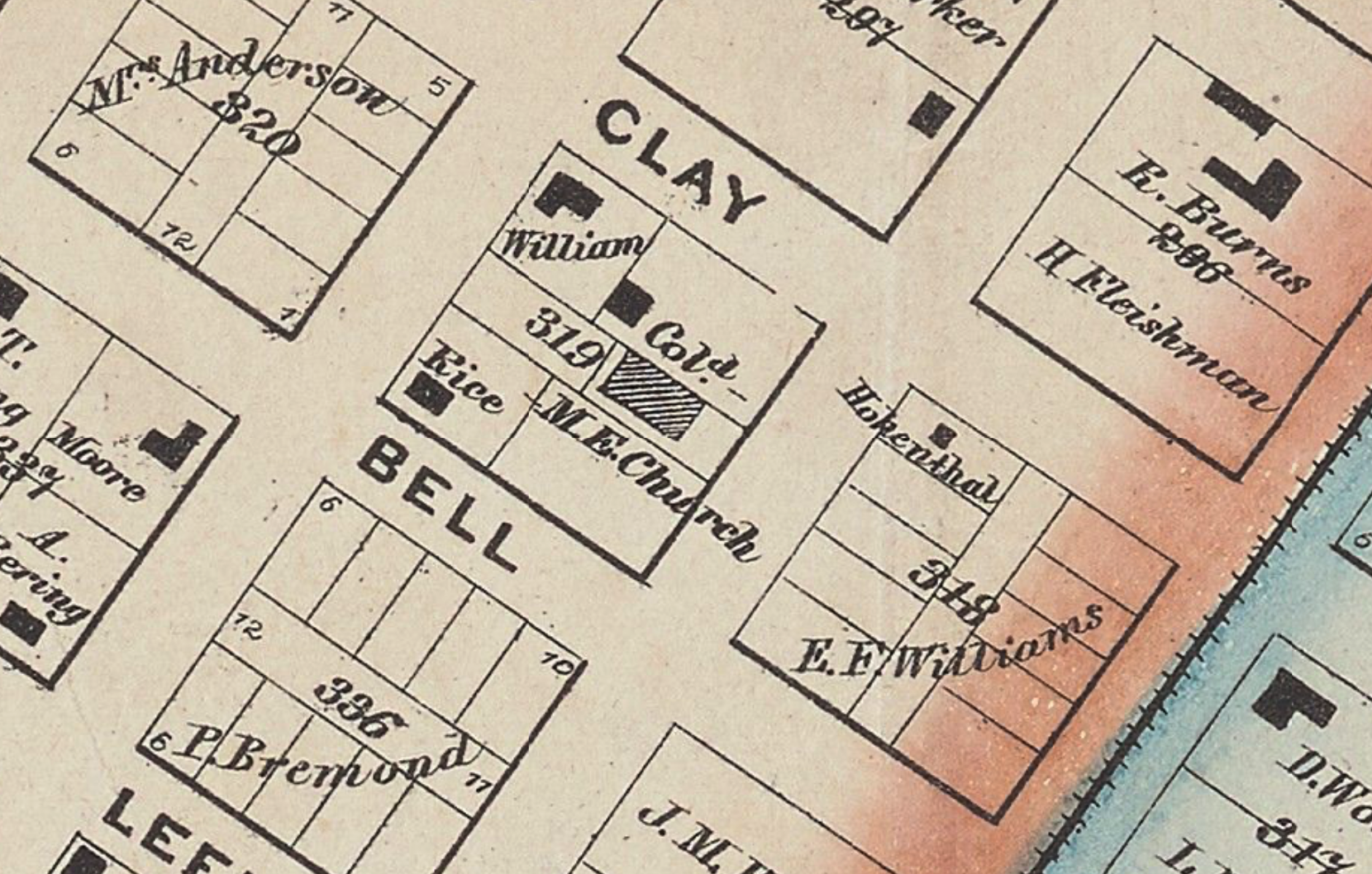
Figure 2: This cropped image from an 1869 map of Houston shows Block 319 and the Black Methodist church that was erected there by May 1866. The block served as the starting point for the first Juneteenth procession in Houston a few weeks later. Courtesy of Beinecke Library, Yale University.
At this new location, bounded by Travis, Bell, Milam, and Clay Streets, the growing church led by Dibble would later become known as Trinity Methodist Church, and in coming years, the trustees would encourage Black homeowners to build dwellings behind the sanctuary on the same lot, making it a center of community life. In short, six years before the purchase of the ten acres that became known as Emancipation Park, and barely nine months after Granger’s Juneteenth order, Black Methodists had already purchased valuable real estate and were making their mark on the city’s map and religious landscape. In March 1866, TheNew Orleans Advocate published a sermon by Dibble that proclaimed the “joy and gladness” felt by every saved Christian. Yet his words also surely reflected the joy of freedom from any “Master” except “the Saviour.” “We need not be astonished if the Christian shouts,” Dibble preached, “for he has had his feet taken out of the pit of mire and clay, and placed upon the rock; and new songs have been put in his mouth, even praise to God.” [19]
Indeed, the successful relocation of the Black Methodists’ church called for celebration, and in May 1866, only a few weeks before the first anniversary of Juneteenth, members of the congregation likely participated in at least two public events designed to demonstrate all that had been accomplished. First, the managers of the city’s freedmen’s schools—including Stuart’s—announced plans to hold a picnic on May 10. Poor weather spoiled that occasion, but a fortnight later, according to newspaper reports, the “colored population” turned out in “very large” numbers for another picnic. This second event began on May 23 with a procession through the city’s major streets, led by “marshal music” made by “a whistle” and a drum made from “a dry goods box.” The parade, commented the Evening Star, was a “novel scene” for the city, as Black Houstonians “marched through Main street with great pomp.” [20] The “several hundred” marchers “of all ages and sexes” then proceeded to an unnamed picnic site on the outskirts of town, possibly around the newly moved Black Methodist church, where a “Queen of May” was crowned. [21]
Unfortunately, this event, too, was marred by rain, and “the luxurious tables that were to have been spread” at the picnic site went unused. Heavy downpours turned Houston’s streets into gumbo, and the Evening Star sneered about the marchers muddying their clothes. [22] But a few days later, on May 29, the Evening Star became the first newspaper in town to report on a third planned celebration: “We learn that there is to be a grand anniversary of the first annual round of the day on which the colored population of Houston were proclaimed free.” On June 13, the Evening Star then followed up with a story about the upcoming “Colored Barbecue” and reported that “great preparations are being made,” with tickets being sold at a price of one dollar each. [23]
The two picnics rained on in May would shortly become mere prologues to a much bigger event: the festivities by which “the freedmen of Houston would celebrate the 19th prox. as the first anniversary of their freedom.” That celebration on June 19 would ultimately include the parade that featured Dibble and Parker as its leaders. And it would begin, fittingly, at the site of the new Methodist Church on Block 319. [24] Yet as the above recital of events shows, there was nothing foreordained about the selection of June 19 for an event to celebrate emancipation in Houston. The earliest newspaper reports did not even mention plans for another parade—only a “big dinner” that may have been intended to replace the picnic rained out on May 23. [25] If Dibble’s congregation had securely controlled its own property on January 1 of that year, they may well have celebrated emancipation on that day, much like the church’s MEC counterpart in Galveston. As we have seen, however, it was not until February that the Houston church had purchased a lot, and not until April that the moving of the chapel began. Those actions may even explain why tickets were being sold for the barbecue. As the correspondent for the Methodist New Orleans Advocate reported that spring, the “effort needful for the . . . purchase and removal” of the church had “seriously interfered” with efforts to build the paper’s subscription list in Houston. While available evidence does not make clear how the funds from the ticket sales were used, they may have helped to offset the church’s recent expenses. Whatever the case, plans for the June 19 observance clearly owed much to the new independence of the city’s Black Baptists and Methodists. [26]
Equally clearly, the actions of these churches had more than spiritual implications. In at least three ways, they were political, too. First, the actions taken by churches like Dibble’s exercised new, legally enforceable rights to property and incorporation. According to The New Orleans Advocate in March, the entry of the Black Methodist trustees’ names into public records made the church “the second incorporated society among the colored people in Texas.” While congregations like Dibble’s may have exercised customary rights over property under slavery, the purchase of real estate backed by a deed was also something new. As the Advocate continued, “under the new order of things, they are guaranteed the rights of property, and may protect it before the law.” [27]
Second, the churches’ alliances with Northern missionaries and agents of the Freedmen’s Bureau underscored their political allegiance to the federal government. The Evening Star noted that the music played on May 23 was “patriotic,” while reporting that one youth marching in the procession had looked up at the “stars and stripes” and “exclaimed in ecstasy ‘I do believe we are in the Union!’” The white reporter mocked the comment, joking that the youth was actually “in union with darkness and superstition,” but the true reality could not be disguised. In a city still rife with Confederate sentiment, Black Houstonians attached their hopes to the national flag. [28]
Finally, as previous scholars have noted, simply by holding processions and picnics, Black Houstonians asserted equal rights to the use of public space, even at the real risk of violence. On June 20, 1865, just a day after Granger’s Juneteenth order, a Black cook named William who arrived in Houston with US troops had been murdered by a “Mr. Cotton,” allegedly for violating white expectations about the use of a sidewalk. [29] In the year that followed, Black Houstonians became regular targets of racist violence in city streets and racist invective in city newspapers. Angered by the postwar influx of freedpeople to Houston, white editors denounced the newcomers as vagrants and complained of their supposed savagery, ignorance, and immorality. The city columnist for the Telegraph regularly displayed such “bitter animosity against the negro population” that even some white readers criticized his tone, yet the paper made no apologies: “We are satisfied that the negroes in this city are a gang of the worst scoundrels that ever went unhung.” [30]
The columnist for the Telegraph claimed to draw a distinction between “black villains” and “the honest freedmen or women,” yet he also stigmatized Black churchgoers, claiming in October 1865 that a melee had broken out at a service of the Mt. Zion Church and in January 1866 that a “deadly feud” was going on between some Black Baptists and Methodists, leading to regular “church disturbances.” The Evening Star, meanwhile, criticized the city’s Black congregations for their worship styles, commenting on May 29, 1866, “that when they get together they commence singing spiritual songs; and before the preacher gets ready to deal out the word of truth to them, they get so full of the spirit, that a general out-burst breaks forth in shouts, cries, dancing, which forms a conglomerated mixture of all ages and sex” that was “contrary to the scriptures.” Such articles reveal that in Houston, as elsewhere, African American women as well as men were actively creating a new Black public sphere—and that their activities were closely scrutinized. In breaking from proslavery churches, congregations like Dibble’s and Parker’s had escaped supervision, but not surveillance. [31]
All of this ensured that whenever Black Houstonians stepped as a group into city streets, their claiming of public space was a political act. That was especially true, however, in May and June 1866, as heavy rains were ruining that year’s cotton crops in Texas and many white planters were blaming poor yields on the liberties taken by freedpeople leaving the fields for the city. Many rural Black workers were in fact coming to town to report to Freedmen’s Bureau agents about the violence and coercion they still faced in the countryside. Yet even the Bureau seemed sympathetic to the planters’ views. On June 19, 1866, the first anniversary of Granger’s General Order No. 3, Gen. J. B. Kiddoo of the Freedmen’s Bureau issued Circular No. 17 from his headquarters in Galveston, ordering agents to tour their districts and “lecture” the freedmen on “the duties to their employers.” Houston editorials urged officials either to return vagrants to plantations or to imprison them and force them to labor on public works. [32]
These labor conflicts in the city and countryside unfolded at a moment when the future of political Reconstruction in Texas was also hotly contested. Since being elevated to the White House after Abraham Lincoln’s assassination in April 1865, President Andrew Johnson had pushed for the rapid reconstruction of Confederate states. He quickly recognized a provisional state government led by Unionist governor Andrew J. Hamilton and made clear he was open to restoring Texas to full rights within the Union once it adopted a constitution that confirmed the abolition of slavery. Conservative Southerners thus hoped to meet Johnson’s criteria for admission without doing much else to reform prewar institutions. A convention made up exclusively of white men met in Austin in February 1866 to draft a new state constitution, which would recognize the basic civil rights of Black Texans to own property and enter contracts—but otherwise maintain white supremacy. It denied Black Texans any right to vote or hold office, reducing them to a permanently subordinate class and confining the vast majority to plantation labor. When the convention adjourned, the date was set for a statewide vote to ratify this constitution and choose new officeholders. That election would be held on June 25, 1866. [33]
These events unavoidably shaped the context in which Black Houstonians were planning to mark the first anniversary of freedom on June 19. As we have already seen, Black Houstonians had begun planning the event as early as May 29, shortly after their waterlogged May 23 parade. But then, on May 31, Governor Hamilton issued an explosive proclamation: Only those former Confederates who had successfully applied for amnesty and sworn an oath of loyalty to the government would be permitted to vote in the upcoming election on June 25. Though Hamilton hoped to empower the state’s tiny, embattled party of white Unionists, the order sparked outrage among conservative white Democrats, who complained that Hamilton was overreaching his authority by depriving many Confederate veterans of their vote. On June 14, two weeks after the governor’s proclamation, white Houstonians decided to use a major parade of the city’s volunteer firefighting companies to express their mounting grievance. [34]
As June 14 approached, newspapers announced that all the city’s fire companies would process through the streets with their engines, and they would be joined by firemen from Galveston. The mayor ordered all shops closed for the “Firemen’s Celebration,” and two local Confederate luminaries were chosen as marshals: Colonel William T. Austin, also a veteran of the Texas Revolution, and lawyer Peter W. Gray, who had served in the secession convention and the Confederate government. What happened on the day itself would later come under dispute. After the parade of companies, which Austin and Gray led while “mounted on ‘war-horses,’” some locals claimed that Gray had spoken with US military officials in the city to get permission for the march. But federal officers remembered things differently. Though concerned about the parade’s Confederate cast, US officials realized they did not have enough troops on hand to police it and so were advised by local Unionists to let the firemen proceed. Other reports claimed that Freedmen’s Bureau officers had given different advice, recognizing the parade as a potentially volatile display of conservative sentiment and urging their army counterparts to stop it. [35]
Yet the firemen’s parade went on; a political firestorm ensued. On June 14, as the procession passed US military headquarters in Houston, the marchers boldly stopped to make cheers to Jefferson Davis while a band played “Dixie,” and some witnesses reported that “the Confederate flag was used.” The band played no patriotic tunes, and no US flag was seen along the line of march or at the ball that followed, making it “plain . . . that a premeditated insult to the Federal Government was intended,” as the moderate Republican paper Flake’s Bulletin (published in Galveston) reported in its June 17 issue. Flake’s called out for special censure the final parade float, constructed by the “Hook and Ladder” company. Their truck, drawn by four white horses, featured a “monument in memory of the Confederate dead.” Upon it, according to the Evening Star, sat a young white girl in mourning for “the ‘dead nation’ and its martyrs.” Some stars on her costume representing the former Confederate states were covered with black crepe, and “she wore manacles on her hands, with chains at her feet, as indicative of the condition of her own native land.” As the EveningStar concluded, “She did not represent the Goddess of Liberty (as some of the Federal officers supposed,) but the South, the down-trodden, the oppressed South.” [36]
The pro-Confederate message of the parade was clear, as was the political implication: Only a large turnout for the new constitution on June 25 could rid Texas of Yankee rule. Racial hostility also erupted into violence on the day of the parade. According to one Freedmen’s Bureau report, a group of five “rowdy firemen assaulted an inoffensive freedman” named James Duncan in Houston. The firemen pulled Duncan from the seat of the hack he was driving, beat him mercilessly, and stole his pistol. In response, exclaimed the outraged Bureau agent, “A policeman then took Duncan into custody!!!” The reactionary intent of the fireman’s parade was so obvious that it sparked an investigation by military officials into the “alleged seditious matters” at the parade, and numerous editorials in state Republican newspapers criticized the march. Meanwhile, conservative newspapers claimed that “so-called Union men, alias Texas Radicals,” were overreacting: “They pretend to see the ghost of the dead Confederacy rising from her bloody grave, and the shades of the departed rebels flit before their distempered fancies.” Radicals “have been spitting venom and striking with their fangs for months past,” fumed one pseudonymous writer, “and it is time they were scotched, if not crushed, that is to say, politically speaking.” [37]
Such was the immediate context in which Black Houstonians prepared to celebrate the first anniversary of emancipation on June 19—a date that arrived less than a week after the firemen’s parade, and less than a week before white Texans went to the polls. Plans for the event had been in the works even before the fire festival, but to continue with those plans now—and with a parade as well as a picnic—was clearly a politically potent and potentially dangerous decision. Between the lines of newspaper reports, there were signs that Black Houstonians were concerned about opposition to their march. On June 13 the Evening Star downplayed the concern: “We do not believe there is a family in Houston who would refuse to give the colored people one day for the purpose of thanksgiving, speech-making and merriment.” In the wake of the firemen’s parade, however, caution became newly warranted on all sides. Even the city’s white editors took pains to warn their readers to refrain from interference with the emancipation celebration. “We earnestly trust that nothing will be done by the inconsiderate or ill-disposed to interrupt or mar the merry-making of the freedmen,” intoned the Telegraph on the morning of the nineteenth. The EveningStar published a similar warning the day before: “We trust they may have a merry time, and that nothing will come up to mar the peace and pleasures of the occasion.” [38]
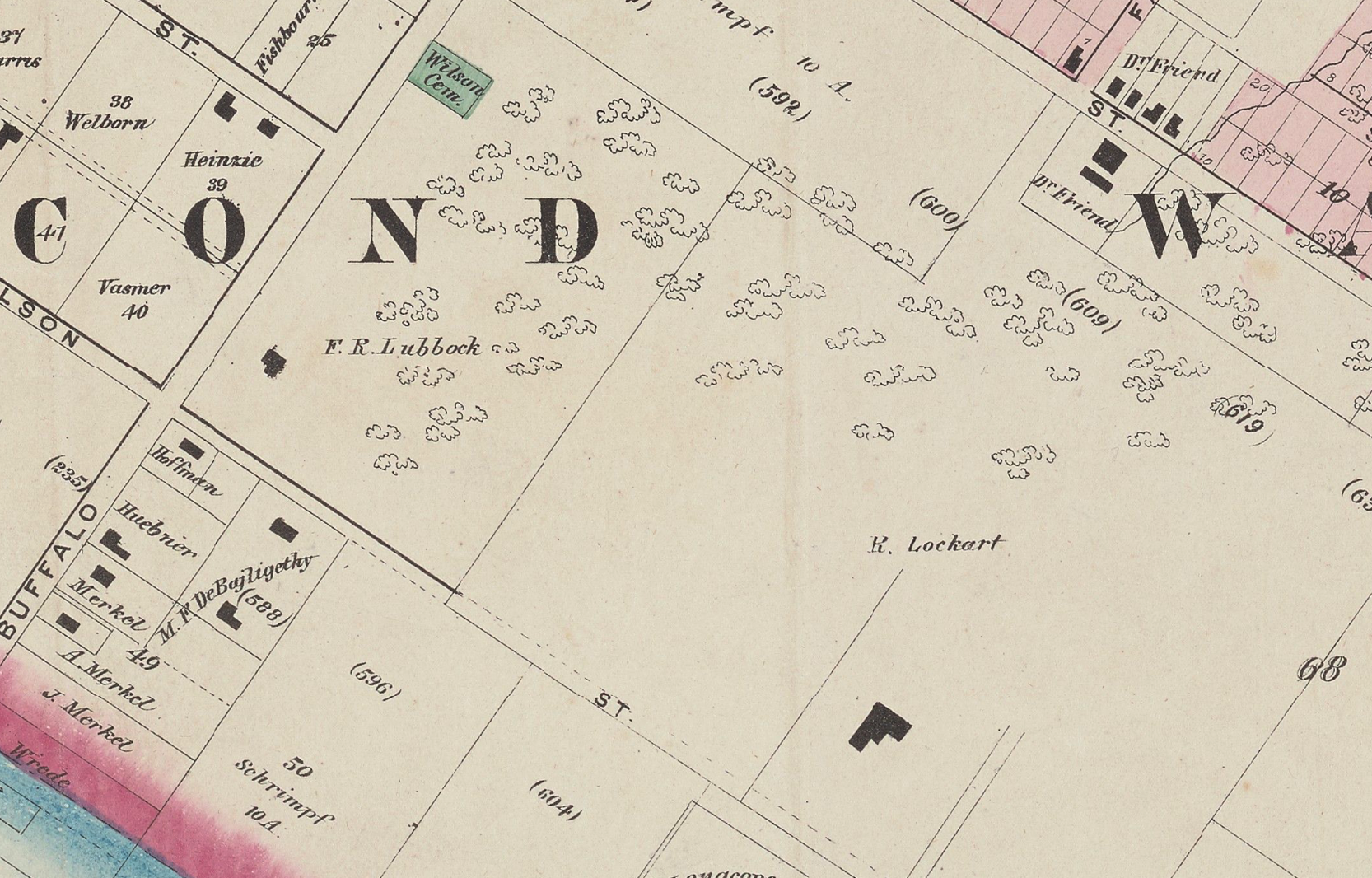
Taking no chances, the June 19 organizers appear to have tried to defuse danger in two ways. First, according to the EveningStar, they planned “to invite their old masters and mistresses” to the picnic, a decision the editor attributed to “the respect in which they hold their former friends.” In truth, strategic conciliation likely played the greater part. [39] Diplomacy may also explain a second decision by organizers: to end their procession at “a beautiful grove of trees near Mr. Lockhart’s,” located on the eastern outskirts of the city in the Second Ward. Though born in Pennsylvania, Robert Lockart was a Democrat, a former enslaver, and a brother-in-law of Texas’s first Confederate governor Francis Lubbock, who owned property adjacent to the same grove. Though the march to this grove would take the procession by the Mt. Zion Baptist church, Lockart’s property was not at all close to the Black Methodist church on Travis Street. Choosing a venue so far out of town and closely tied to white elites may have been a canny, strategic move made by Black leaders. [40]
Figure 3: This cropped image from an 1869 map of Houston shows the Second Ward grove between the homes of Robert Lockart and Francis Lubbock where the first Juneteenth procession ended for a picnic. Courtesy of Beinecke Library, Yale University.
On the other hand, opening the grove may have served a strategic purpose for white Houstonians who favored a speedy end to occupation. With the suspicions of the military aroused by the June 14 parade, and with Republicans in Congress growing more critical by the day of Presidential Reconstruction, white Houstonians might have calculated that it was in their interest to extend some support, or at least tolerance, for the freedpeople’s celebration. “We believe, and justly too,” said the Telegraph, “that we, their old masters, are still the best friends the negroes have; let us prove it on this and on all occasions.” The Evening Star agreed, urging white readers not to do “anything that would . . . give our enemies ground to believe that we are not true to the professions we have made.” [41]
Still, to anyone who witnessed the events of June 19, 1866, the messages of the day were clear, as were the political implications: Black Houstonians knew that the United States government, at that moment, was their best ally. As the community gathered at the Black Methodist church that morning for the march, the day’s officers mounted their horses wearing sashes of red, white, and blue. In stark contrast to the firemen only a few days before, marchers carried a “great number of United States banners from the size of a pocket handkerchief up to a bed quilt,” and as they set out from the church, they “marched in regular order . . . under the protecting folds of the American flag, which waved majestically over them.” Arriving at the “beautiful retreat, chosen for the barbecue, they then marched round and round in several different forms for some minutes, when in the centre was erected a United States flag, around which a large crowd gathered to hear some orations from the freedmen.” In the wake of the controversy over the “Hook and Ladder” float, the martial formations and panoply of flags on June 19 left no doubt about Black Houstonians’ true political loyalties. [42]
More than just a performance of patriotism, though, the procession was a demonstration of local pride and labor power. According to the Evening Star, the marshals were followed immediately by a group of Black draymen—the wagon drivers whose work was essential in transporting cotton and merchandise through city streets. (Perhaps significantly, this was also the profession of James Duncan, the Black driver who had been beaten, robbed, and then arrested by city police only a few days before.) Behind the draymen marched some of the oldest Black Houstonians, whose place in the parade not only recognized their lifelong labors under slavery but also identified them as critical early denizens of the city. (In the firemen’s celebration, by contrast, the marshals of the parade had been followed by the city’s white “pioneers,” a distinction that Black organizers now implicitly claimed for the elders in their community.) And several new voluntary associations rounded out the procession: “the Freedmen’s Mutual Aid Society” (established by Dibble the previous fall), “then the Debating Society, next the Baptist Mutual Aid Society,” and then a huge crowd of individual marchers, “male and female, old and young, large and small.” [43]
The participation of women in the day’s festivities continued at the grove itself, where the correspondent for the Evening Star found the “good sisters were singing their spiritual songs.” Unfortunately, the reporter did not record the speeches given at the grove or the names of any speakers, but the reported size of the crowd spoke volumes by itself. Whereas the May 23 marchers had numbered only several hundred, the grove on June 19 was crowded with “3,000 or 4,000 people,” more than the city’s total Black population at the time. The streets were “thronged” with visitors who had come into town not only from Galveston, as the Evening Star reported, but “from the country,” too. The Telegraph noted that “one small wagon alone came in, in full tilt, loaded with sixteen men, women and children.” [44]
Among the city’s conservative editors, the visitors prompted renewed grumbling about the shortage of laborers in the cotton fields. The Evening Star immediately followed its lengthy report about the picnic with a complaint that freed people seemed “to prefer to squat down in some . . . hovel in the city, or in some little town or village, to going to constant and honest employment in the country.” What such bitterness could not diminish, though, was the evidence that Black Houstonians had pulled off an impressive show of strength, eliciting a huge turnout from city and country alike. According to the Telegraph, the event “turned out to be, as everybody expected, a very big thing,” and “everything passed off in a most pleasant and agreeable manner to those concerned.” [45]
Unable to dismiss the day’s success, some white Houstonians sowed doubts about whether Black Houstonians themselves had been in charge. Rumors spread that the whole event had been orchestrated by Bureau teacher Henry W. Stuart. But the Tri-Weekly Telegraph addressed and refuted these rumors in its July 13 issue: “We are informed on the best authority . . . that the thing was altogether in the hands of the negroes, and that Stuart had no more to do with it than any other white man.” In short, it was ultimately to their credit alone that Black Houstonians had managed to inaugurate the celebration of June 19, and in coming years, they would take pride in continuing the tradition. [46]
By the time the second anniversary of Juneteenth came around, much had changed in Houston. The city’s African American population had continued to grow, filling desks and pews in churches and schools. The Black Baptists, led by Parker, experienced some of the greatest growth, especially after a visit by the Black minister Israel S. Campbell in 1867 added some 170 souls to the church, which now called itself Antioch. Among the new members was Jack Yates, a drayman who had moved from Matagorda County to Houston after the war and later took on the mantle of leadership at the church. By the middle of 1867, the Antioch Baptists had moved into a new sanctuary in the Fourth Ward, a simple wooden structure near the corner of Rusk and Bagby Streets on a site soon known as “Baptist Hill.” Located near the Black neighborhood called Freedmen’s Town, Antioch’s first building quickly joined the Methodist church as another center of community life and empowerment. [47]
Indeed, on July 4, 1867, four hundred Black Texans would crowd inside the Baptist church for a state Republican Party convention, followed by a barbecue in the Fourth Ward. Parker and Dibble both attended the conference as delegates from Houston, showing their continued roles as political as well as spiritual leaders. The convention also highlighted another major change since the first Juneteenth: the enfranchisement of Black men. [48] At the state election held on June 25, 1866, white Texans had voted to approve the conservative 1866 constitution, but by the next year, national Republicans had seized the reins of Reconstruction away from President Johnson. In March 1867, the Congress placed former Confederate states, including Texas, back under military rule, unless and until the rebel states drafted new, more egalitarian state constitutions, adopted without racial restrictions on suffrage. That summer, accordingly, Black Texans began organizing in Republican Union Leagues and registering to vote for the first time. In Harris County, registration began on June 12, 1867. Dibble and Parker left their own marks on the voting rolls on June 14. [49]
Five days later, and with registration still ongoing, Black Houstonians celebrated the second anniversary of June 19. This time, with political tensions even higher than the year before, Houston’s newspapers did not speak of the event. But in 1867 Black Houstonians were joined in their observance of June 19 by freedpeople in other towns, including Austin and Huntsville, where 3,500 people turned out for a “celebration of the second anniversary of the termination of the domestic institution in the State of Texas.” The “freedmen of Walker County” attended a barbecue where funds were raised for a “Freedmen’s Church.” [50] Yet some celebrations that year still took place on dates other than June 19, underscoring that consensus around that date was not yet inevitable. On June 12, 1867, for example, a Freedmen’s Bureau agent in Columbus, Colorado County, informed his counterpart in Richmond, Fort Bend County, that “my ‘collod pussuns’ are going to celebrate their Emancipation” on June 22, a Saturday, “and as yours are to do it on Friday [June 14], I have the honor to invite you up to be with us.” The Richmond agent brought American flags to the Columbus ceremony, which featured a procession of more than nine hundred marchers. [51]
A visitor who observed the Columbus parade recorded his surprise at the event’s timing: “The negroes in Houston celebrated the 19th,” he noted in a letter to the Galveston Daily News, “and after inquiring why different days were appointed, I was informed that they do not select the actual day upon which their freedom was achieved . . . but the day on which they first heard the fact.” The comment—implying that what was being celebrated was the news of emancipation, instead of its enforcement—was one of the earliest examples of a misleading version of the Juneteenth story that later became widespread. At the same time, this observer underlined a fact that would later be forgotten: It was the “negroes in Houston” who established the pattern of celebrating on June 19. [52]
In 1868, the celebration of June 19 was apparently skipped in Houston after a violent altercation five days earlier sparked fears of race riots in the city, but Black Houstonians resumed their observance of June 19 in 1869, 1870, 1871, and 1872. In all four years, the Black Methodist church remained a primary site for assembly, and in three of the four years, the Baptist minister Sandy Parker remained an officer of the day. In 1869, a published letter cosigned by Parker also gave a precise definition of what June 19 commemorated: not the news of freedom, but “the anniversary of the order enforcing President Lincoln’s Emancipation Proclamation, issued by Gen. Gordon Granger.” Organizers clearly had their eyes on posterity, too. “The colored people of Harris county will celebrate Emancipation Day (Saturday, the 19th of June,)” in Houston, said one announcement in the city’s Republican newspaper, the Daily Union. “Speakers, preachers and teachers of colored schools throughout the country are requested to give notice of this fact on all occasions.” [53]
After June 19 in 1872, Black Baptists and Methodists joined forces again to raise funds for the purchase of a ten-acre park that could serve as a permanent site for annual celebrations. By 1875, Parker had died, yet the holiday he had a hand in founding was flourishing at this new site in the Third Ward, eventually known as Emancipation Park. For the tenth anniversary of Granger’s order, a procession made up of “the various colored clubs, the colored base ballists, followed by numerous negroes from the country on horseback, and accompanied by the colored band, marched through Main street out to the freedmen’s grounds.” The president of the day was none other than Elias Dibble. [54]
Figure 4: A photograph of a marker at Emancipation Park in Houston that honors Elias Dibble’s role in the creation of the park. His role in the first Juneteenth in 1866 has not previously been reported. Photograph by author.
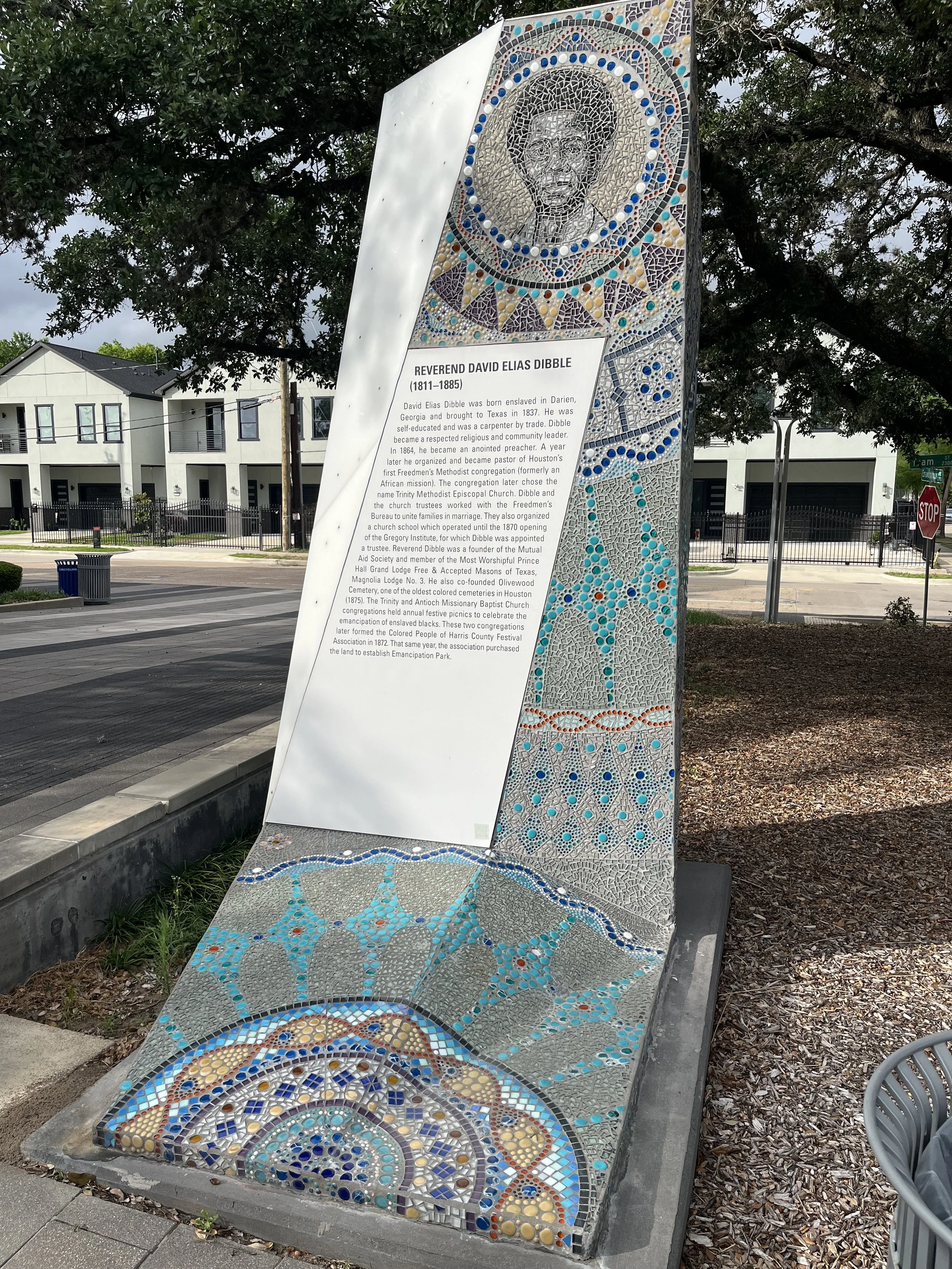
Today, Dibble’s contributions to the origins of Emancipation Park are publicly recognized in Houston, including with a display at the park itself. Visitors learn, as well, about the leading roles played in fundraising for the park by Antioch Baptist Church and Jack Yates. The story of Emancipation Park is rightly remembered as a story about Black Houstonians’ early acquisition of real estate in the wake of slavery, as well as their early commitment to Juneteenth. Yet over the years in which the park’s story has become more widely known, the stories of the very first Juneteenth holiday—and Black Houstonians’ roles in its genesis—have been largely overlooked.
Remembering the starting point now is important because it sheds light on the longer story. The prominent roles of Parker and Dibble in later celebrations make sense because they had presided over Juneteenth from the first. A longer view stretching back to 1866 also frames the purchase of Emancipation Park not as a new departure, but as a continuation and culmination. The pursuit of independence and real estate had defined the earliest histories of the city’s Black churches, from the purchase of Block 319 by Black Methodists to the construction of Antioch’s first building on Baptist Hill. Those acquisitions, too, were related to the meaning of Juneteenth.
Finally, and most of all, the 1866 story reveals that Juneteenth, from the beginning, was always about more than remembrance or recreation. It was a holiday that pressed political claims to equality in the present, bravely countering ideologies of white supremacy with a far different imagining of the nation’s future. That the celebration of June 19 continued into the twenty-first century, becoming a state holiday in 1980 and a national holiday in 2021, is thanks to the work of a long line of communities and leaders, especially Black Texans, who made sure it survived. It is a procession of names that began first in 1866—with Elias Dibble, Sandy Parker, and the Black Texans who followed them in formation through the streets of Reconstruction Houston, waving and wearing the colors of the United States.
###
Further Reading: For more about "Freedmen's Celebration," the 1866 article from the Houston Evening Star that serves as a crucial source in this article, see the author's post on The First Juneteenth in Houston and the digitized copy of the newspaper available on The Portal to Texas History.
Endnotes
[1] Tri-Weekly Telegraph (Houston), June 20, 1866, 2 (first quotation); “Freedmen’s Celebration,” Daily Evening Star (Houston), June 20, 1866, 3 (names of officers); June 16, 1866, 2 (second quotation). “Freedmen’s Celebration” also named Richard Sessum as deputy marshal. All references to page numbers in the Tri-Weekly Telegraph and the Daily Evening Star (a paper missing from earlier accounts of Houston’s first Juneteenth) refer to digitized issues on the Portal to Texas History, https://texashistory.unt.edu. Although June 19 was not initially known as Juneteenth, I use the term throughout this article for ease of reference.
[2] “Freedmen’s Celebration.” See also Edward T. Cotham, Jr., Juneteenth: The Story Behind the Celebration (State House Press, 2021); Carl H. Moneyhon, “Emancipation Day to Juneteenth: The Origins of a Texas Celebration,” Southwestern Historical Quarterly 128, no. 1 (July 2024): 6, which notes that “Houston became the first town known to observe the anniversary of emancipation on June 19”; Donald J. Norman-Cox, “Making Sense of Juneteenth: A Diagnostic Survey of the Historical, Ideological, and Performative Constructs of Texas Emancipation Day as Told through Texas Newspapers” (PhD diss., University of North Texas, 2025), 15–16; Elizabeth Hayes Turner, “‘Three Cheers to Freedom and Equal Rights to All’: Juneteenth and the Meaning of Citizenship,” in Lone Star Unionism, Dissent, and Resistance: Other Sides of Civil War Texas, ed. Jesús de la Teja (University of Oklahoma Press, 2016), 195–225; Elizabeth Hayes Turner, “Juneteenth: Emancipation and Memory,” in Lone Star Pasts: Memory and History in Texas, ed. Gregg Cantrell and Elizabeth Hayes Turner (Texas A&M University Press, 2007), 143–175; Shenette Garrett-Scott, “‘When Peace Come’: Teaching the Significance of Juneteenth,” Black History Bulletin 76, no. 2 (Summer–Fall 2013): 19–25; Annette Gordon-Reed, On Juneteenth (Liveright, 2021).
[3] On public political culture, see Elsa Barkley Brown, “Negotiating and Transforming the Public Sphere: African American Political Life in the Transition from Slavery to Freedom,” Public Culture 7 (1994): 107–146; Elsa Barkley Brown and Gregg D. Kimball, “Mapping the Terrain of Black Richmond,” in The New African American Urban History, ed. Kenneth W. Goings and Raymond A. Mohl (SAGE Publications, 1996), 66–115; Kathleen Ann Clark, Defining Moments: African American Commemoration and Political Culture in the South, 1863–1913 (University of North Carolina Press, 2005).
[4] Turner, “‘Three Cheers to Freedom,’” 210 (first quotation); Moneyhon, “Emancipation Day to Juneteenth,” 6 (second quotation). For demographics, see Howard Beeth and Cary D. Wintz, eds., Black Dixie: Afro-Texan History and Culture in Houston (Texas A&M University, 1992), 19–23; Char Miller and David R. Johnson, “The Rise of Urban Texas,” in Urban Texas: Politics and Development, ed. Char Miller and Heywood T. Sanders (Texas A&M University, 1990), 3–12.
[5] “Freedmen’s Celebration.” See also Charles A. Israel, “From Biracial to Segregated Churches: Black and White Protestants in Houston, Texas, 1840–1870,” Southwestern Historical Quarterly 101, no. 4 (April 1998): 428–458; Kenneth K. Bailey, “The Post–Civil War Racial Separations in Southern Protestantism: Another Look,” Church History 46 (December 1977): 453–473.
[6] Israel, “From Biracial to Segregated Churches,” 431–438, esp. 436 (second quotation) and 437–438 (first quotation); W. A. Leonard, comp., Houston City Directory for 1866 (Gray, Strickland & Co, 1866), 113 (third and fourth quotations); Hunter O. Brooks, Historic Highlights of the Antioch Missionary Baptist Church of Christ, Inc., 1866–1976 (Antioch, 1976), 1, in Jack Yates and Antioch Baptist Collection (MSS 0281), Box 3, Folder 6, African American History Research Center (AAHRC), Houston Public Library (HPL).
[7] In the 1870 census, Parker’s birthplace was listed as Kentucky, and his occupation was listed as “Minister Gospel.” See Ninth US Census, 1870, Houston Ward 4, page 608, available on FamilySearch.org. For his brief obituary, see Weekly Telegraph (Houston), January 9, 1873, 5. See also The Red Book of Houston: A Compendium of Social, Professional, Religious, Educational, and Industrial Interests of Houston’s Colored Population (Sotex, 1915), 22, 72. On Yates, see Beeth and Wintz, eds., Black Dixie, 24–26.
[8] Minutes of the Twenty-Seventh Annual Meeting of the Union Baptist Association, Held with the Brenham Church, Commencing on Friday, August 17th, Ending Monday 20th, 1866 (Gray Smallwood & Co., 1866), 4, 9 (quotation), 15.
[9] Daniel W. Stowell, Rebuilding Zion: The Religious Reconstruction of the South, 1863–1877 (Oxford University Press, 1998), esp. chapters 1 and 5; Sarah Barringer Gordon, “Staying in Place: Southern Methodists, the Colored Methodist Episcopal Church, and Postwar Battles for Control of Church Property,” Journal of the Civil War Era 13, no. 3 (September 2023): 281–315.
[10] Stowell, Rebuilding Zion, chap. 8; Walter N. Vernon, Robert W. Sledge, Robert C. Monk, and Norman W. Spellman, The Methodist Excitement in Texas: A History (Texas United Methodist Historical Society, 1984), 125–126; New Orleans Advocate, January 6, 1866, 1, available on the Internet Archive.
[11] Moneyhon, “Emancipation Day to Juneteenth,” 4–5; Galveston Historical Foundation, Galveston’s Juneteenth Story: And Still We Rise (The History Press, 2024), 44; Vernon, Sledge, Monk, and Spellman, Methodist Excitement in Texas, 125; Carolyn Henley, “Reedy Chapel, the Oldest Negro A.M.E. Church in Texas,” Junior Historian 26, no. 4 (January 1966): 26–28.
[12] Israel, “From Biracial to Segregated Churches,” 432, 436.
[13] “The City,” Tri-Weekly Telegraph, October 6, 1865, 5; Leonard, comp., Houston City Directory for 1866, 112.
[14] Israel, “From Biracial to Segregated Churches,” 446–447; Harris County Deed Books, Vol. 2, p. 345; Minutes of the Annual Conferences of the Methodist Episcopal Church for the Year 1866 (Carlton & Porter, 1866), 5.
[15] Leonard, comp., HoustonCity Directory for 1866, 111.
[16] Byron Porter to Wm. H. Sinclair, June 4, 1866, Records of the Superintendent of Education for the State of Texas, Bureau of Refugees, Freedmen, and Abandoned Lands (BRFAL), National Archives and Records Administration (NARA) microfilm, M822, Roll 10, available on FamilySearch.org (first quotation); George W. Honey to E. M. Wheelock, March 22, 1866, NARA, M822, Roll 10 (second quotation); Tri-Weekly Telegraph, November 24, 1865, 5 (Stuart quotations).
[17]Tri-Weekly Telegraph, November 24, 1865, 5; December 20, 1865, 15. On the revivals, see New Orleans Advocate, March 24, 1866, 3; March 31, 1866, 1; April 14, 1866, 1; April 21, 1866, 2; May 19, 1866, 1.
[18] Harris County Deed Books Vol. 2, p. 318; “From Texas District,” New Orleans Advocate, March 31, 1866, 1 (quotation); Daily Evening Star, April 21, 1866, 3; April 30, 1866, 3; May 28, 1866, 3; Israel, “From Biracial to Segregated Churches,” 449.
[19] “A Sermon, by Rev. Elias Dibble, (Colored,) Houston, Texas,” New Orleans Advocate, March 3, 1866, 3, 4. See also Israel, “From Biracial to Segregated Churches,” 446–449.
[20] Daily Evening Star, May 9, 1866, 3; May 10, 1866, 3; May 11, 1866, 3; May 23, 1866, 3 (first quotation); May 24, 1866, 3 (other quotations).
[21] Tri-Weekly Telegraph, May 25, 1866, 4.
[22] Tri-Weekly Telegraph, May 25, 1866, 4; Daily Evening Star, May 24, 1866, 3.
[23] Daily Evening Star, May 29, 1866, 3; “Colored Barbecue,” Daily Evening Star, June 13, 1866, 3.
[24]Daily Evening Star, June 16, 1866, 2.
[25]Daily Evening Star, May 29, 1866, 3.
[26] “From Texas District.”
[27] “From Texas District.” On the shift from customary to legally enforceable property and incorporation, see Dylan C. Penningroth, Before the Movement: The Hidden History of Black Civil Rights (Liveright, 2023).
[28] Daily Evening Star, May 24, 1866, 3.
[29] William’s name is recorded in “Records Relating to Murders, Outrages, and Other Criminal Offenses,” in Records of the Assistant Commissioner for the State of Texas (RACT), BRFAL, NARA microfilm M821, Roll 32. See also Turner, “‘Three Cheers for Freedom,’” 204; Moneyhon, “Emancipation Day to Juneteenth,” 5; “Letter from Houston,” Galveston Daily News, May 18, 1866, 2; Galveston Daily News, June 21, 1865, 2.
[30] Tri-Weekly Telegraph, July 28, 1865, 4. See also Beeth and Wintz, eds., Black Dixie, 20–21; Louise Passey Maxwell, “Freedmantown: The Origins of a Black Neighborhood in Houston, 1865–1880,” in Bricks without Straw: A Comprehensive History of African Americans in Texas, ed. David A. Williams (Eakin Press, 1997), 131.
[31] Tri-Weekly Telegraph, July 28, 1865, 4 (first and second quotations); October 2, 1865, 5, 7; January 31, 1866, 7 (third and fourth quotations); Daily Evening Star, May 29, 1866, 3.
[32] “Circulars and Circular Letters Issued, October 12, 1865–December 8, 1868,” Records of the Assistant Commissioner for Texas, BRFAL, NARA microfilm M821, Roll 19, Target 2. See also Carl H. Moneyhon, Texas After the Civil War: The Struggle of Reconstruction (Texas A&M University Press, 2004), 55–60; “The Cotton Crop,” Tri-Weekly Telegraph, June 4, 1866, 16. For editorials on vagrancy, see “The City” column of the Tri-Weekly Telegraph in almost any issue for late 1865 and early 1866.
[33] “The Fourth Monday in June,” Daily Evening Star, May 10, 1866, 2.
[34] Moneyhon, Texas After the Civil War, 50.
[35] “The Firemen’s Celebration,” Daily Evening Star, June 15, 1866, 2 (quotation); Tri-Weekly Telegraph, June 13, 1866, 9; June 15, 1866, 2; “Houston Fire Festival,” Daily Flake’s Bulletin (Galveston), June 20, 1866, 4. Page numbers for Flake’s Bulletin refer to the digitized issues in America’s Historical Newspapers from Readex.
[36] “Houston Fire Festival”; “The Houston Festival,” Daily Flake’s Bulletin, June 17, 1866, 4; “The Firemen’s Celebration.”
[37] “Records Relating to Murders, Outrages, and Other Criminal Offenses”; Daily Flake’s Bulletin, June 28, 1866, 4 (“alleged seditious matters”); “A Spat from Ultimus,” Galveston Daily News, June 21, 1866, 1, available on Newspapers.com.
[38] “Colored Barbecue”; Tri-Weekly Telegraph, June 20, 1866, 2 (which contains news from June 19); Daily Evening Star, June 18, 1866, 3.
[39] Daily Evening Star, May 29, 1866, 3.
[40] “Freedmen’s Celebration.” Lockart is listed in the Slave Schedule of the 1860 Census as the owner of twenty-two enslaved people in Houston, Harris County. Sometimes known as Lubbock’s Grove, this grove was also used for other public events. See Thomas McWhorter, “From Das Zweiter to El Segundo: A Brief History of Houston’s Second Ward,” Houston History 8, no. 1 (2010): 38–42.
[41] Tri-Weekly Telegraph, June 20, 1866, 2; Daily Evening Star, June 16, 1866, 2.
[42] “Freedmen’s Celebration.”
[43] “Freedmen’s Celebration.” For the pioneers in the earlier parade, see “The Firemen’s Celebration.”
[44] “Freedmen’s Celebration”; Daily Evening Star, June 18, 1866, 3; Tri-Weekly Telegraph, June 20, 1866, 11.
[45] “Freedmen’s Celebration”; Tri-Weekly Telegraph, June 20, 1866, 11.
[46]Tri-Weekly Telegraph, July 13, 1866, 9. For the rumors, see Daily Evening Star, July 12, 1866, 3. Never welcomed by whites since his arrival in town, Stuart’s imperious air and use of corporal punishment in the classroom had eventually alienated his colleagues and Black Houstonians as well. On June 19 itself, Stuart spent part of the day writing an aggrieved letter to his superior defending his reputation. Soon thereafter he left Houston. See E. M. Wheelock to Henry W. Stuart, June 12, 1866; Stuart to Wheelock, June 19, 1866; G. W. Honey to Wheelock, February 17, 1866, and April 3, 1866; and M. O’Regan to Wheelock, November 6, 1866, all in NARA microfilm, M822, Roll 10.
[47] Brooks, Historic Highlights of the Antioch Missionary Baptist Church of Christ. According to church histories, before the “Baptist Hill” building, the church had been worshipping in a brush arbor on Buffalo Bayou. See also Rutherford B. H. Yates and Paul L. Yates, The Life and Efforts of Jack Yates (Texas Southern University Press, 1985), 11–15.
[48]Daily Flake’s Bulletin, July 5, 1867, 2, 5; Semi-Weekly Flake’s Bulletin (Galveston), July 10, 1867, 3, 4.
[49] Harris County, Texas, US, Voter Registration Lists, 1867–1869, on Ancestry.com. See also Carl H. Moneyhon, The Union League and Biracial Politics in Reconstruction Texas (Texas A&M University Press, 2021).
[50] “Freedmen’s Celebration,” Daily Flake’s Bulletin, June 27, 1867, 2. See also Moneyhon, “Emancipation Day to Juneteenth,” 8–9; “Railroad Meeting at Huntsville,” Semi-Weekly Flake’s Bulletin, June 29, 1867, 7.
[51] Texas Freedmen’s Bureau Field Offices, Columbus, Letters Sent, vol. 1 (73), April 1867–February 1868, NARA microfilm, M1912, Roll 16, Image 157 of 518 on FamilySearch.org; “Pencilings of a Journey into Texas,” Galveston Daily News, June 30, 1867, 1.
[52] “Pencilings of a Journey into Texas.”
[53] Houston Daily Union, May 21, 1869 (second and third quotations); June 18, 1869; June 21, 1869 (first quotation); June 18, 1870; June 20, 1871. See also Houston Daily Telegraph, June 20, 1872. For 1868, see Moneyhon, “Emancipation Day to Juneteenth,” 10.
[54] The Age (Houston), June 19, 1875, 2; Galveston Daily News, June 20, 1875. On Emancipation Park, see Carroll Parrott Blue, “Emancipation is a Park,” Houston History 9, no. 3 (2012): 15–18.